HPE Discover Research Note,
By Jean S. Bozman, Cloud Architects LLC

Anticipating the rapid growth of agentic AI, HPE is skillfully blending the way its expanded portfolio of networking products and services will support a new wave of emerging enterprise-wide requirements. Its scope will be wide – including edge, campus, data center infrastructure and AI “factories” near end-customers.
Focusing on the challenges of deploying AI across customers’ end-to-end IT landscapes, HPE is leveraging its 2025 acquisition of Juniper Networks to drive home its key marketing messages about ensuring performance and security for enterprise AI. It expects that enterprise customers will be listening closely, as they update data centers for scale-up AI-enabled workloads, and the ability to support and accelerate agentic AI workloads.
At its HPE Discover conference in Las Vegas this June, HPE promised its customers that it will provide “secure, self-driving networks across every domain.”
Speed, performance and enterprise-wide AI enablement from Core to Cloud to Edge were all key themes of HPE’s Discover conference. By integrating its networking products with distributed software tools for customers’ evolving management platforms, HPE plans to improve overall end-to-end performance of a wide spectrum of AI-enabled workloads.
Keynote Focus on Networking
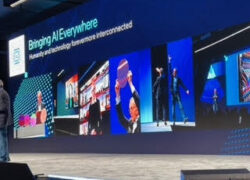
HPE CEO Antonio Neri explained the role of HPE’s expanded networking offers to customers in his keynote HPE Discover address: “Networking to connect your infrastructure and workloads at scale; cloud to enable you with the hybrid operating model to run your workloads and applications where they belong; and AI to turn your data into intelligence and put it to work.”
More specifically, “For years, HPE Aruba networking has helped you deliver secure connectivity across campus, branch and the edge, creating the digital onramp that connects your users, devices and data,” Neri said in his HPE Discover keynote. “With the addition of Juniper Networks [in 2025], we have extended that leadership into the data center and across the critical networks connecting the AI era,” he said, adding: “Scale up, scale out and scale across.”
Expanded AI Ops Software Rollout
Enterprise customers joined HPE executives on the HPE Discover stage, to speak about the effectiveness of combining networking deployments on their firm’s business results. Among them: pharmaceuticals giant Eli Lilly; Mercedes Racing on real-time access to distributed data generated locally; Heineken International; the Royal Bank of Canada on integrating network services enterprise-wide; Siemens Energy; and Vultr, a hyperscaler firm that is expanding its AI infrastructure with GPU clusters and accelerated networking.
Rami Rahim, who is President, Executive Vice President and general manager of HPE Networking, presented a wide-ranging keynote about building and deploying self-driving networks with three important attributes: AI-native architectures, enablement for agentic AI, and end-to-end security.
As Rahim described it, this self-driving network infrastructure provides 24 x 7 robust monitoring of enterprise networking, hardware, and software. Combining AI-native operations, observability, and automation capabilities across the HPE Networking portfolio provides real-time feedback about network operations, allowing the overall network framework to quickly respond to correct any network interruptions it detects.
In her keynote, Fidelma Russo, EVP, President & GM, Hybrid Cloud & Chief Technology Officer, explained how agentic AI are already changing the calculus of infrastructure-building and IT economics, in her keynote. “Agents don’t stop after one response, she said, comparing agentic AI with earlier forms of AI. “They continuously reason, they continuously coordinate, and they continuously interact with other systems,” she said from the HPE Discover main stage.
There’s no question that , even now, ongoing network operations are being transformed by agentic AI, as each act of coordination can generate additional AI inference activity and token processing, eventually generating many thousands of tokens per week, month or fiscal quarter. The adoption of agentic AI is continuously updating the state of the data and the state of the network, she said. “And what that means is that inference is a continuous operational workload, not a one-time request.” And that, in turn, is giving rise to a new economics for the enterprise – with the largest data centers generating millions of “tokens” as they work around the clock.
For providers like HPE, this means that agentic AI could accelerate AI-related software deployments. The chief takeaway of that talk is clear: Because the network itself is constantly changing, operating it within customers’ fast-growing enterprise networks will require a software infrastructure supporting ongoing updates, governance, and monitoring, along with robust security. One example of the AI-enablement phenomenon is the HPE Marvis AI and self-driving networking capabilities, which is now being extended across broader Aruba Central experiences and capabilities, along with new and expanded capabilities designed to simplify data-center operations.
Core to Cloud to Edge
The networking theme fits with longtime HPE technologies, including HPE’s Aruba Central; HPE Greenlake for data management and the newly acquired HPE Mist software for managing distributed systems. “With our combined HPE networking organization,’ HPE CEO Neri said, “our goal is to deliver the best user and operator experience possible.
More than feeds and speeds, HPE highlighted its attention on longtime IT issues, such as data-management issues associated with too many “inputs” from a broad array of networking and software-management products across customers’ data centers. In previous era, the task of tracking and coordinating management inputs was a pain-point.
With agentic AI, the focus is on data quality and optimizing data locations that will result in cost-effective systems that produce better business results. As AI becomes more distributed throughout the entire enterprise – with many inference systems located close to where the data originates, such as regional centers and factories.
The networking strategy described at HPE Discover is expected to improve overall AI efficiency and cost-effectiveness. However, as always, the true proof that self-driving networks will accelerate agentic AI deployments will be found in real-world proofs of concepts (PoCs), beta tests, and production-level performance reviews.
HPE’s theme of building self-driving networks fits with longtime HPE technologies, including HPE’s Aruba Central; HPE GreenLake, HPE’s hybrid cloud platform and the HPE Mist AI-native networking operations platform. “With our combined HPE networking organization,’ HPE CEO Neri said, “our goal is to deliver the best user and operator experience possible.”
Optimizing data location
Optimizing data location is an important way to reduce unproductive data-movement across multiple networking tiers, while improving the performance of data that is moving closer to the customer’s end-sites and end-users.
This approach has a special impact on AI inference systems that are located on the Edge in the customers’ IT landscape. Moving data across the network is not always productive, especially in cases when most of the AI model-training data is centered at company headquarters or major regional centers. As was mentioned in the HPE keynotes, the adage “move the application to the data – not the other way around” exemplifies this approach.
As that data-placement optimization happens, the process will require deliberate planning – rather than de facto placement of data that just happened to be in the geographic locations where it was stored in data silos. Now, enterprises must give deep thought to how and where to locate large data-stores – or sacrifice the goal of fast and efficient processing. HPE is also offering HPE services to evaluate, to assess and to redeploy more efficient deployments, if needed.
Building on Networking Revenues from the Juniper Acquisition
The emphasis on HPE’s networking investments, including the close of the Juniper acquisition in July, 2025, was seen during an earlier event – HPE’s fourth-quarter earnings announcements last fall.
As HPE CEO Antonio Neri presaged in a December, 2025, Yahoo Finance interview about the company’s fourth-quarter results:
“We are now a networking-centric company,” Neri said then [in December, 2025]. “And you can see that in the gross margin at 36%. We made remarkable progress in such a short period of time, integrating Juniper. And that progress was demonstrated. As a combined business, we grew on a pro forma basis out of the gate, and we delivered amazing innovation [that we showed] this past week at Barcelona [in December, 2025], where we announced a number of breakthrough technology innovations in campus and branch, switching, routing and security. So, all-in-all, a very strong quarter for us.”
Analysis
In a world where agentic AI is rapidly adopted, traditional enterprise management controls will have to be modified – and perhaps changed dramatically. Diversity of customers’ management tools will be the rule — not the exception – and unification of consoles will be a priority in avoiding I/O slowdowns across AI-enabled enterprise systems.
Unless a path is found for cost-effective management, the AI agents themselves would get lost in the entanglement of highly diverse software tools. In that scenario, the rapid growth of agentic AI could overtake progress from AI-enablement, with tokens skyrocketing – and confounding those who manage their networks with more traditional management tools.
That is precisely where the major systems vendors and cloud operators are focusing right now. It is nothing less than a fundamental re-think of the traditional infrastructure “stack” of the data center and the cloud. And that is why this moment is such an inflection point for the age of AI – many vendors are pulling in the direction of applying new technologies to adapt to the new world of AI-enabled infrastructure.
To do that, networking, systems and storage providers must work to reduce barriers between data repositories – and to support efficient orchestration of the millions of virtual machines (VMs) created over the last 25 years of computing. They must help customers to consolidate infrastructure, making it more capable of boosting faster end-to-end performance, while supporting an emerging AI-centric infrastructure that depends on fast-and-accurate networking as a foundation for the world of agentic AI.
Competing providers are also tackling the AI infrastructure challenges for customers, including networking requirements. Among infrastructure vendors and cloud services companies that have highlighted their AI-infrastructure strategies in recent months are Dell Technologies Inc., IBM, and Lenovo, along with cloud providers AWS, Google Cloud, and Microsoft Azure and regional CSPs worldwide in EMEA (Europe/Middle East/Africa), in the Americas (North America and South America) and in Asia/Pacific (including China, Japan and Korea).
Summary
Networking is the catalyst for improving end-to-end performance that “reaches” across the Core, the Cloud and the Edge to gain optimized AI processing that spans the enterprise. This approach is leveraging networking connections to link many-to- many computing clusters across the expanse of a company’s IT landscape.
Benefits to enterprise customers include better scale-up AI in data centers, more efficient scale-out across distributed sites on the Cloud, and improved Edge computing close to the end-customers’ work sites.
Clearly, this cross-enterprise, AI-enabled networking cannot be done without providing the appropriate security, efficient compute, adequate storage of large data, along with enhanced orchestration of VMs and dependable resilience of hardware platforms.
In short, it is a multi-dimensional problem with no single, simple equation to solve it all. Customers entering the world of agentic AI must come to terms with the demands of such important deployments. However, with careful and appropriate planning, processing bottlenecks can be removed or minimized – and end-to-end throughput can be maximized.
In its HPE Discover conference in June, HPE showed that it is paying careful attention to all of these factors, and that it is focusing on customers’ business outcomes by applying AI-enhanced engineered solutions that will support more applications in a thorough and performant way for the emerging AI era.