
Cliff, Cliff on the Hill: Which Emerging Computing Technologies (ECT) to Watch in 2013?

Our best wishes to you, your families and friends for a Happy, Healthy, and Prosperous New Year. Much of 2012 was a stimulating hike through the emerging computing technology (ECT) landscape; with the last month or so being an exciting steep ascent culminating at the ECT Cliff. Our year-end climb started with our participation at the exciting annual <a href=”http://sc12.supercomputing.org/” target=”_blank” rel=”noopener”>Supercomputing 2012</a> event (#SC12) in Salt Lake City in Utah. Then, we attended the annual #IBM Software Analyst Insights conference in Stamford, CT. And finally, we attended the monthly Connecticut Chief Technology Officers (CTO) club in mid-December before winding down for our annual holiday in 2012.

Already, 2013 is shaping to be an exciting year here in Connecticut. Fortunately, we did not fall over the cliff – fiscal or otherwise. It is refreshingly cold and crisp here. And after this morning’s stimulating hike, I pause and reflect on what the hike through ECT landscape in 2013 may look like from the edge of this ECT cliff while relishing a breathtaking view that is truly amazing – gazing at the horizon taking in the first rays emanating from the rising sun. Reflections on what the ECT landscape may look like 2013 are almost as wondrous and awesome as the rising sun. But unlike the sunrise that can be predicted with great accuracy, ECT predictions even for a relatively near-term horizon i.e. only 2013 could be far off-target!
But rather than just provide my undoubtedly biased individual view, I thought, it may be valuable to share what a small group of Southern Connecticut CTOs viewed as key ECT items to watch in 2013.

December 2012 Connecticut CTO Club Meeting Informal Survey – 2013 will be the Year for Analytics!


At our last CTO club meeting for 2012, we had a vigorous and stimulating discussion on what the group assembled there considered were the key emerging computing technologies to watch in 2013. We put up a list and then this group of about 18 individuals representing technical leaders across various companies – large and small – in southern Connecticut and New York – voted on whether they thought these technologies were Over-Hyped, Under-Hyped, or Just Right.
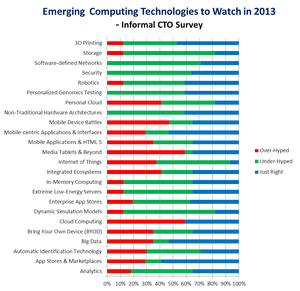
Some items in the list were broad areas i.e. Storage and Analytics. While others were very specific technologies i.e. Automatic Identification Technologies, Personalized Genomic Testing, and In-Memory Computing. So, there was considerable variance in this list. Nevertheless, being an informal list, it covered considerable ground in the ECT landscape. We even listed broad mature categories like Storage as they have emerging technologies to watch i.e. Solid State Disks, Flash Memory, etc. Clearly, Extreme Low-energy Servers are just emerging as a category. Here are the informal survey results.
 
 
Some key observations from the above chart: The topics most thought were over-hyped were Cloud Computing and Tablets. The ones they thought were most under-hyped was Software-Defined Networks, followed by Dynamic Simulation Models and Automatic Identification Technology, along with Non-Traditional Hardware Architectures (GPU computing and ARM) , Extreme Low-Energy Servers, In-Memory Computing, and the Internet of Things.
When asked what were the technologies that would have the most impact in 2013, Analytics won in a landslide (58% mentioned it). Cloud Computing (35%), Big Data (29%) and BYOD (also 29%) also did well. So perhaps, 2013 will be the year of Analytics!

Greater the Impacts When Several ECT Trends Combine …..


We are always awed by the potential impact of any one ECT trend, but we become ecstatic when several ECT trends combine together to significantly improve our personal and professional lives….each ray of the rising sun is lovely, but when these rays coalesce and illuminate the vast gorgeous valley below the cliff, that view is breathtakingly stunning!

First, let’s just consider four larger ECT category trends: mobile, cloud, analytics, and social. When mobile and cloud combine, we get the CloudMobile! With Software Everyware and in the CloudMobile we can leverage the power of SocialAnalytics. Next, with a High Performance Computing (HPC) infrastructure, which someone aptly said is constantly emerging, we can support mankind’s ECT journey. And with Storage, Personalized Genomics Testing, and Non-Traditional Hardware Architectures capable of large In-Memory Computing, we could develop Novel Next Generation Genetic Sequencing solutions that could significantly change the Economics of Healthcare!

….. Under the Leadership of Enterprising Individuals


But we need enterprising doers, managers, and leaders to invent, develop, nurture, evangelize, adopt, and use these Emerging Computing Technologies. In 2012, we have been very fortunate to interact with several enterprising individuals. Clearly, the members of the Connecticut CTO club and the Faculty, Staff and Industry Members of the Wharton Emerging Technology Center are enterprising individuals with a passion for ECT. But I wanted to specifically call out others who we recently met or interacted with at #SC12 or the IBM Software Analyst Insights event. These individuals (doers, managers, and leaders all in one) have enriched our lives with their passion for ECT.

Combining the promise of Big Data with the power of High Performance Computing and Analytics is Gord Sissons, Sr. Marketing Manager at IBM Platform Computing for the IBM Platform Symphony offering. Joe Landman, CEO of Scalable Informatics is pushing the envelope in very high performance storage. Gord and Joe are classic examples of entrepreneurs and technical innovators. Chad Harrington, VP of Marketing at Adaptive Computing – a HPC and Cloud Software Company is a top-notch evangelizer of the business value of ECT as is Karl Freund, VP of Marketing at Calxeda, a company building extreme low-energy servers. Last but not the least is Jim Corgel, General Manager of IBM’s Developer Relations organization. At the IBM Analyst Insights event, I had the unique opportunity to listen to Jim talking about how he plans to expand the very successful IBM Global Entrepreneur Program. While I was definitely in agreement with the content and strategy of Jim’s presentation, I was even more impressed with Jim’s passion and zeal to drive innovation in the partner ecosystem with targeted initiatives around four ECT areas: cloud, social, mobile and analytics. Jim’s body language and presentation exuded the passion and optimism of a doer typically found in technology entrepreneurs and innovators. This, in my opinion, is rare especially given Jim’s immense responsibilities of managing a partner ecosystem worth over tens of billions of dollars to IBM.

2013: The Best Year for Emerging Computing Technologies Yet – Let’s All Smile.


Despite Connecticut’s (and the entire Tristate area’s) travails with the recent devastation caused by hurricane Sandy and the absolutely horrific shooting in Newtown, CT (this is just a few miles away from my home), 2013 will be good a year. This is almost as definite as tomorrow’s magnificent sunrise – I remember vividly sitting at the deck of my friend’s (Bob DeLuccia – a Biotech entrepreneur himself and now co-founder of DiPexium Pharmaceuticals ) home on the shore at Long Beach Island in New Jersey this past summer discussing how delightful it is to witness the splendor of the rising sun. Fortunately, Bob’s house suffered minimal damage from hurricane Sandy.

Entrepreneurs and the enterprising individuals involved with ECT are, by nature, optimistic. One of the greatest compliments I received, in a prior life as CEO of a startup software company, from our lead investor – just as he was pushing us towards a Chapter 11 bankruptcy – was that I remained optimistic about the immense market potential of our startup’s software technology. That is probably a manifestation of the Karmic values and the Gandhian outlook that were part of my upbringing. Gandhi was clearly a rare transformational leader in a millennium. But almost every day for an hour or so, he as a doer, sat silently and intensely concentrated on his manual task of making cloth with a Spinning Wheel.
Our job, as IT analysts, is to similarly concentrate and meticulously observe with awe and analyze and catalog the wonderful impacts of these marvelous emerging computing technologies in 2013. But nothing makes me more euphoric than to witness one of my twin boy’s mischievous smiles. And when both twin boys smile mischievously together, that euphoria more than doubles!

Ratcheting up the “Flops”, the US regains Supercomputing Leadership. Keep the Innovation Flame on!

This week’s big supercomputing story – It’s Red, White and Blue and … Green too!
 
 
This past Monday (June/17), as I was sitting outside; reading and enjoying the nice sunny weather on the East Coast, I received an email alert that delighted me and put me on a joyous reflective state. At ISC 2012, the Top500 list of supercomputers worldwide firmly established that, after a span of almost three years, the United States has regained that envious and prestigious floating point performance leadership position in supercomputing or High Performance Computing (#HPC) – wresting this away from other world-class manufacturers.

Blue is Green Too!


The fastest supercomputer in the world is the IBM BlueGene/Q (Sequoia), installed at the Lawrence Livermore National Laboratory, and achieved an impressive 16.32 petaflops/s on the Linpack benchmark using 1,572,864 cores. The BlueGene/Q is also the top system in the Graph500 list, which ranks supercomputers by a data intensive benchmark that mirrors workloads common in graph applications including social networks, cyber security, and medical informatics. And the BlueGene/Q is also the Greenest supercomputer according to the Green500 list that ranks supercomputers by energy-efficiency benchmarks! Moreover, the fastest supercomputer in Europe is the SuperMUC, an IBM iDataplex system installed at the Leibniz-Rechenzentrum in Germany and cooled by warm water.

You can get more details from the Top500, the Green500, and the Graph500 lists of supercomputers. But if you want to truly get a detailed (the what, how and why) perspective on the innovations that underpin these spectacular results, please read our recent papers on the BlueGene/Q and the iDataPlex:
 

  1. IBM Blue Gene/Q: The Most Energy Efficient Green Solution for High Performance Computing
  2. Beyond PetaFlops: Scalable, Energy Efficient IBM System x iDataPlex dx360 M4 powered by Intel Xeon processor E5-2600 Product Family
  3. The IBM System x iDataPlex dx360 M4: Superior Energy Efficiency and Total Cost of Ownership for Petascale Technical Computing

The Eternal Flame of Innovation


This is a great testament to US innovation in the computer industry. Going forward, one fundamental question/challenge in supercomputer design is; how can we keep heat away and cool these systems to run reliably and efficient as we scale up performance? For this, innovations in cooling technologies, low-power processors, and the rest of the technologies must all come together to build that gigantic jigsaw puzzle – the exascale system! The center of gravity of this pursuit, while historically firmly entrenched in the US since the dawn of the information age, seems to be lately seesawing between the US and Asia. Today, it is in the US. One question is how can the US reinforce and sustain this edge and arrest this seesawing jigsaw?

However, a bigger question is how can the US keep the flame and heat on the escalating tussle for an edge in innovation and on the seesawing race for leadership in today’s global knowledge economy? Today (June/21/2012) this heat is literally on. It is not only the longest day in the northern hemisphere but it is also the hottest day here in Connecticut! The sprint towards exascale is just one proxy for this larger battle.

To win, we must flex our neurons. For this we need relentless focus and continuing investment in education – particularly in math, science, and language. Our teachers are our personal trainers and the classroom is the gym. But beyond, traditional classroom education, we must experiment, constantly learn on the job and not be afraid to make and learn from Brilliant Mistakes. Moving on and learning from these Brilliant Flops (a.k.a. Mistakes) is of greater benefit to innovation than merely ratcheting up the supercomputing Flops! May the Olympic Torch of Innovation continue to shine on the United States!

Even Bigger than the Internet

The cloud is changing everything. The change is even bigger than the change we saw from the Internet. It will change how every business operates. That’s what a cloud computing expert told me – Roger Krakoff, founder and managing partner of Cloud Computing Partners, a venture capital firm that invests exclusively in cloud computing. I didn’t get it. How could this be? Then I had a second conversation with Roger.

An HBR Analytic Services white paper gave me the core of a cloud computing definition I like: “enables access through the Internet to a shared pool of computing resources (hardware, software, etc.) that can be tapped on demand and configured and scaled up or down as needed.” But it stops there. Thanks to Roger I could now add “by any computing device.” That was the missing link. It’s the mobile implications that make cloud computing transformational – not merely evolutionary. Aha!

But then came an e-mail exchange and Roger’s P.S. “better to think of cloud computing as dial-tone or electric power. It is there when you need it. Pay by the unit and it just works.” Bingo! The cloud is the new utility – like electrical power or water or the Internet! One source of its power to transform businesses is what happens when it handles business transactions. And this is already happening in a really big way.

On May 17th, IBM released the following stats about its enterprise SmartCloud services customers: one million enterprise application users working on the IBM Cloud. More than $100 billion in commerce transactions a year in the cloud. 4.5 million daily client transactions conducted through the IBM Cloud. And that’s just one major vendor of cloud services!

What’s more it’s just the beginning. TopCoder, the world’s largest open innovation community, with 400,000 developers is moving to the IBM SmartCloud Enterprise. From this we can expect an exponential increase in innovation, as these developers support the organizations for which they work with the entire innovation process – from ideation, software engineering and analytics to implementation, testing and support.

At YouTube (http://www.youtube.com/ibmcloud) I found the moving story of how the cloud has transformed the Bari fishing industry – and made life better for the fishermen and their families with a new business model. Until recently, the fishermen caught too many fish. They exceeded market demand, Thanks to cloud computing, they can now communicate how many fish they are catching in real time and a virtual market can sell the fish before the boats dock. Now they catch only as many fish as the market consumes, their income is up 25 percent and the time to market is down 70 percent. Wow! That’s innovation that matters!

What Difference Does it Make?

What differences does it make? That’s the first question for every entrepreneur and innovator.

The country – and the world for that matter – is buzzing with new start ups. Most of them will fail of course and it won't matter because most really don’t makd a difference for anyone.

How does your product differentiate itself? That’s what the investor will ask – because being different from other products that serve similar purposes is fundamental to being marketable.

But isn’t it time for new companies and new products to make a difference as well as differentiate? We live in a time when every product category is already saturated with options. That’s why branding has become hot. Creating a distinctive image in the minds of customers is the sine qua non of differentiation. Now some entrepreneurs and innovators are adding an important new dimension to differentiating. They are creating new ways to improve the quality of life.

Arshad Chowdhury did that to create Cleargears, a startup that promises to make a difference for employees of any company sufficiently enlightened to deploy it. What it delivers is a system for real-time performance review by everyone of everyone. Unlike the traditional process – and that hasn’t changed for years – where performance review occurs in huge chunks once a year from the narrow perspective of people at the top, Clearview delivers ongoing feedback in bite-sized chunks from the 360-degree perspective of everyone you work with - anonymously. The vision of Arshad and his early customers alike is that companies can perform better if they help everyone on the team perform better as well

Sandy Heck, MD, is making a difference with Reach Bionics, a start up that is developing technology to help paraplegics wirelessly control electronic devices by activating vestigial muscles around the ears.

Michael Huerta and his partners at BrightPath Energy are making a difference by applying their skills in providing capital and deal infrastructure to the renewable energy sector. One of their first projects is Power.ly, an angel-stage product company that solves cost and logistical problems for remote electricity - such as post-disaster, rural areas, the battlefield, or anywhere the grid is limited – with a truly portable generator that uses solar power.

When I’m lucky enough to discover start ups like these, I hear Stevie Wonder’s lyrics echo in my head: “And I think to myself, what a wonderful world.”

The New News: Vox Populi

  • A new Greenpeace campaign targets Apple’s cloud computing products, as it looks to “clean the cloud around the world.
  • A smooth animation of a timelapse of planet Earth from ‘Electro-L’, a geostationary satellite orbiting 40,000 kilometres above the Earth.
  • A blind-folded guy entertainingly told at his bachelor party that he’s about to bungee-jump 50 feet – only it’s more like 5 feet into a pool of water!
  • Honda’s new ‘UNI-CUB’ personal mobility device.
  • A graphic undercover investigation, by the Humane Society of the United States, into the walking horse industry discovers cases of rampant cruelty.

These are Storyful Daily’s “Five of the best on YouTube” for today. Not exactly “all the news that’s fit to print” or any other major daily’s take on world news, is it?

To the five best on YouTube, Storyful adds its five best in sport, five best in weather and five general stories – Frankfurt protesters, fans mourning the death of disco queen Donna Summer, a PAC plan to attack Obama, the effect of a Twitter hashtag on a Spanish bank and a live-tweeted journey through a region facing a hunger crisis.

It’s the new news from Storyful, the brainchild of an Irish journalist. Storyful’s professional journalists sift “actionable news” from the chaff of the real-time web for use by news organizations throughout the world, acting as a “social media ‘field producer'” and providing an online window into their findings for the general public. For both its media clients and the general public, the result is access to authentic views on recent events or developments and early warnings of what could be big stories to come. It adds a valuable social dimension to what we call “news.”

The New Communication: Electronic, Social & Mobile Media

For some years, I had six phone lines on each of two instruments and a phone at one ear or the other – sometimes both – many hours a day. I also had a third instrument with my private line to be sure I could call out no matter what and certain key people could always reach me.

Now I’m so rarely on the phone that I often don’t even bother to check for voice mail messages. It’s easy to manage with merely one land line phone and a cell phone! Lots of people find all they need is the cell phone.

What happened? We abandoned synchronous communication and gained control of our time. We send and receive text and email messages instead of calling. We also went from long-form to bite-sized messages and, at the same time, to more frequent brief interactions.

Not long after the new communication formats started, social media entered my life – Facebook about 2002, Linked In a few years later and Twitter after that. I have what one friend calls “a robust presence” on all three but spend little time on Facebook, not much more on Twitter and probably the most on Linked In. On Facebook, it’s fun to interact periodically with distant friends at times we’d typically have no communication. On Twitter, it’s helpful to discover and share insights. Linked In has become an invaluable reference tool, only rarely used to communicate, let alone interact, but the only way to reach some people at times. So all three add value for me in different ways. They supplement live interaction uniquely.

Does any of this replace live interaction? No way! My calendar is full - and it's only thanks to email and text messages that I can keep it straight!

Sherry Turkle, social scientist, author and MIT professor, argues that our increasing use of email, text messaging and social media has a negative impact on the social fabric and demonstrates evidence of diminished expectations of our relationships with other people and of a personal power-grab for control of interactions. Bah, humbug!

Any media can of course be used for positive or negative reasons and with varying results. But, in my experience, contrary to Dr. Turkle’s perception, the new ones enrich the social fabric with an infinite number of contact points that have never existed before, they provide the convenience of communication on demand – free of interaction – and they allow each of us to manage our time more productively without losing touch.

The New Advertising: Frictionless Sharing

Privacy – “the ability of an individual or group to seclude themselves or information about themselves and thereby reveal themselves selectively,” according to Wikipedia” – has become a marketable commodity for millions of consumers, it seems. Given the right “value exchange,” these people can cheerfully accept “frictionless sharing” – automated distribution by marketers to their social networks of their personal information and online activities.

What’s the right kind of value exchange That depends on the individual. It can, for example, be as simple as a sense of self-esteem, coupons or a 4Square badge.

It’s typically all ok to the people involved as long as the process is transparent, and they know who’s doing the distribution and trust them. Some consumers actually interact with brand pages on social networks, in effect, broadcasting their endorsement of the brand to whomever.

What are the chances of legislation or FTC regulation? Probably zero. Technology is growing too fast for legislators or regulators to keep up with it. Ultimately, the market self-corrects anyhow. All marketing benefits from frictionless sharing depend on relevant targeting and willing users.

These were my principal takeaways from this morning’s Gotham Media Ventures discussion at Frankfurt Kurnit by Daniel Berkowitz, of 360i; Jordan Franklin, of Clickable; Marc Hayem, of MicroStrategy; Kathy Leake, of Local Response, and Brett Martin of Sonar. Terri Seligman, of Frankfurt Kurnit, was moderator.

A Time for Transformation, not Mere Change

Once upon a time – about a year ago - traditional publishers fell in love with the colorful screens of mobile devices as a solution to their battle with the popular assumption that information on the Internet wants to be free. Here at last was a way to once again produce a unique product, charge traditional single copy and subscription prices and restore profit margins.

Jason Pontin’s describes the rude awakening in “Why Publishers Don’t Like Apps,” Technology Review, 5.7.12. (http://bit.ly/JgoAAm)

Today, most tablet machines are Apple, and publishers have to pay Apple to sell their products – which means actually losing sales on individual issues. Most serious, when they sell through Apple, they lose direct connection with their readers – the lifeblood of magazines and newspapers.

Technical problems also made adapting print publications to apps challenging. Many publishers ended up with five digital versions of their products to accommodate diverse devices, viewing options and ordinary website HTML pages. And they found the unbudgeted cost of app development both expensive and time consuming. Without their own digital readers, they had no audiences to sell to advertisers and so insufficient incremental revenue to offset the app development cost.

Worst of all, publishers discovered their stories in apps in fact disappointed reader expectations because the stories do not link; they live in walled gardens, closed off from other digital media.

The outcome? Most mobile device owners read news and features on publisher websites, now coded to adapt to smaller screens or using glorified RSS readers. “The paid, expensively developed publishers’ app, with its extravagantly produced digital replica, is dead,” pronounces Pontin.

What happened? Publishers tried to impose old print formats on digital channels – to make an adaptive change, not a transformation. “I hated every moment of our experiment with apps, because it tried to impose something closed, old, and printlike on something open, new, and digital,” writes Pontin.

One aspect of transformation is to go back to basics – to understand the essence of the product and release it from traditional trappings. Barnes & Noble made a major change with its superstore bookstores containing pianos, coffee shops and sofas. Amazon achieved transformation by eliminating the bookstore altogether. Pontin’s solution, like that of Financial Times is to launch an HTML5 version of its website, optimize it for devices, incorporate many applike features and functions and, ultimately, kill the app. What will the new revenue model be once digital content is free? That’s yet to come. Innovations evolve. You don't always get all the answers at once.

As author/futurist Daniel Burrus has said: “There are two primary uses for technology by business and government. The first is to accomplish more with less―to be more efficient and productive. That's how most people use technology, and it's a good use of it. But the second major use of technology―and it's not that common―is to use it to create new products, services, markets and careers.”

Learning to accomplish more with less is an important first step - and it's still happening. But more and more of us now understand enough about technology to create the new, to innovate – that’s transformation, not mere change!

Simply Pure and Purely Simple – Systems, Stacks and Clouds

I recently attended the IBM IMPACT conference. During the keynote, an IBM executive remarked (and I am paraphrasing) – It is very hard to make technology simple. This is a very profound observation.

This morning (May/2), comfortably perched in my aisle seat on the plane, as I return back to the wonderful state of Connecticut, several impressions from IMPACT start to swirl in my mind. So I thought I would clarify or purify these impressions and articulate them as simply as I can. So that I can purge them from my conscious mind-cache yet make them persist in words through this blog post.

Tomorrow, at the strike of dawn in Connecticut, I want to start with a clear and pure mind and continue with my day job (IT Analyst and Consultant) of gathering and analyzing and articulating additional ideas and thoughts to benefit my paying clients who sponsor my consulting projects. I must do that to make a living and ensure the continuing well-being of my children. This is pure and simple.

PureSystems – Patterning and Partnering


IMPACT was quite packed – over 8500 attendees. The solution center opened on April 29 in the evening. I was fortunate to leisurely examine the demos that perked my interest. I spent a significant amount of time examining the various PureSystems exhibits. In particular, I was very impressed seeing the internals of an operating PureFlex system with its dense packaging – servers, storage, and networks.

But I was even more impressed when I spent a significant amount of time with Manhattan Associates – a PureSystems Application Provider partner that focuses on delivering Supply Chain solutions – both for planning and execution. Their very smart and enthusiastic lead technical expert told me that Manhattan Associates has over 15 software products that they have been able to integrate with the PureApplication System using a combination of IBM patterns and Manhattan patterns. This simplicity, he said was a pure delight to clients in retail, logistics, and other areas where optimizing the supply chain is critical for enhancing operational efficiencies.

To date, IBM has over 100 such partnerships and expects to deliver hundreds more similar PurePatterns across various industries with even more partnerships. It will be interesting to quantify the collective ROI that clients receive both in ease of deployment and in ongoing operations from this PureEcosystem.

It is well known that IT operational costs in labor are one of the fastest growing components of the total cost of ownership (TCO). What PureSystems along with the growing portfolio of PurePatterns do is to tackle this head on to make IT simpler to use –similar to the value proposition for cloud computing which has been front and center in the minds of IT organizations worldwide. This brings me to my second set of takeaways from IMPACT.

Cloud OpenStack – Molecules Matter


During the IBM Analyst deep-dive sessions, I got the opportunity to understand the scale and focus of IBM’s Cloud OpenStack initiative. One primary motivation behind this open source initiative is to simplify and standardize Cloud Use Cases and Workloads by building a technology stack using open source and standards to instantiate these use cases. IBM used a very nice chemistry analogy to explain this: system components and their functions are like elements in the periodic table while real-life workloads are like molecules that provide higher level business function and are composed of several pre-wired components (elements).

Then we witnessed a very feature rich demo that depicted a fairly comprehensive cloud business use case. This consortium plans to produce many more of these cloud business use cases and members plan to contribute code and other resources to this initiative. In the next few months, IBM plans to work with other consortium members on governance and process related matters in addition to growing this Ecosystem to include more end-users and application providers.

All this will make these molecules matter even more in the industry. It will further that magical chemistry that continues to fuel the Open Source movement that was born at the dawn of the Internet era. Are we poised to witness another spike in the IT industry with the impending confluence of open source solutions in Big Data, Analytics, and Cloud? The mathematics and technologies for this exist. The bigger question is do we have the knowledge and human capital and the collective wherewithal to leverage all of this? I think so. The first movers have already spoken. The rest will follow. It’s that simple!

OpenStack the PureSystem


IBM was asked several times during the analyst session if there was a plan to extend the Cloud OpenStack to PureSystems. While no formal commitments or announcements were made, I felt from a business strategy perspective, this is a purely simple matter. It will only enhance the PureEcosystem. This chemical bonding will deliver a macro-molecule that could help enterprises deploy clouds in much the same way Enterprise Linux did almost a decade ago. It should also further the collective benefits of Open Source for one and all – pure and simple.

The plane has landed at Westchester Airport. For me the simple act of comfortably flying will now be replaced by the laborious act of having to navigate the traffic on the busy highway (I – 684) that goes north to Danbury, Connecticut. Too bad automobiles are not yet self-navigating and autonomic. But this is bound to happen as cars increasingly become computers in the next decade or so and they get all the intelligent capabilities of sensing and responding in real-time. But this labor of driving through traffic will be very well worth it as I will experience the pure joy of being back at home. After all as a wise man once said Home is where the heart is! That, my dear friend, is pure and simple!

To extend what the IBM executive said at IMPACT – Let us make technology homely! We as IT analysts do – in our own small way – contribute to this goal by trying to communicate as best as we can the value of technology in simple terms.

The Pure Thing

Yesterday, I watched from the comfort of my home office, IBM’s PureSystem “Unveiling of a New Computing Era” announcement in New York City. After the initial background business discussion by Mr. Steve Mills – Sr. Vice President and Group Executive for IBM Systems and Software, the curtain was lifted by Mr. Rod Adkins, IBM Senior Vice President, Systems and Technology Group. At that very instant, with a wide grin, Steve made a comment that I am paraphrasing, “Unlike software with systems, you can actually see the real thing”. When the curtain was lifted, there stood that gleaming blue PureFlex system. This sparked a train of thought that gelled this morning under this spring’s cool Connecticut sun during my customary jog in the park.

What is a Thing?


During my spare time and sometimes to get a real good night’s sleep, I read. One book that does an admirable and efficient job of “accelerating the time to deep slumber” is entitled “What is a Thing?, by Martin Heidegger, one of the greatest 20th century philosophers. I’ve had the pleasure to be about 1/3 the way.

But this morning, reflecting on Steve’s comment, I thought: What is IT (information technology) today? Why is the word “Pure” so relevant? What does this all mean? This created an energizing stream of shedding “thought-vortices” whose trajectories like their fluid mechanics counterparts are difficult to model and predict much less tame and transcribe. But here is where Martin and some reflection come to rescue.

Material and Abstract Things


You see – a system like the PureSystem is something that you can see, touch, and feel. It’s a material thing. Data (even BigData) you cannot see, touch, or feel. But then you can visualize data through software. Software is not a material thing (actually like data it is an abstract thing) but it makes a material impact especially when grounded and optimized on a material thing like a system and then used to solve a business or scientific problem.

Likewise, mathematics (one of the most abstract things) has its profound impact when its “purest” form is applied to solve the challenging problems of the day especially those that have a material impact, for example, the impact of shedding vortices on aircraft operating performance or the calculation of the best available airfare between two cities. All this is of course done in software that runs on a system.

The Everything and Nothing Route to Profound and Pure Insights


But perhaps the most abstract thing, philosophy, and the philosophers who pursue these thought-vortices may take “this thing (whatever that thing is)” and argue that it’s nothing. Just as their other philosopher colleagues could argue that it is everything. That is the duality of zero and infinity. For instance, the great Greek philosopher Aristotle was once asked how he was able to come up with such profound insights. It is rumored that Aristotle answered that he sat in a room and opened all the windows and an avalanche of thoughts came flying into his head which he then curated and came up with profound “pure” insights. That’s BigInsights from BigData.

Contrast this with Buddha who sat in total isolation and completely “emptied” his mind of all thoughts and meditated and came up with yet another set of profound and “pure” insights. That’s starting with a “clean slate”.

The surest (and perhaps purest) thing that I think I know is that I am. But do I really know that? That’s an entirely new and different question for another day.

When Aristotle (West) Meets Buddha (East) in the Cloud


I was told during the IBM PureSystems announcements that IBM worked on this initiative over the last four years; taking input and learnings from thousands of client engagements around the world and came up with this highly optimized, cloud and analytics ready family of systems and platforms. I was also told that the technical architects started with a “clean slate”. That is like marrying East with West to get the best of both worlds and this should be great for clients everyware!

Now lest I get fired from my day job of doing IT analyst work, I must move on to my next “thing” which is finishing up the white paper that my employer wants me to write! That is very material my dear friend! To my children – who read my blogs – note your survival and well-being depend on my finishing this next thing!